Hands-on Brain-Computer Interfaces (BCI) Laboratory
ECBME 4090
Course description
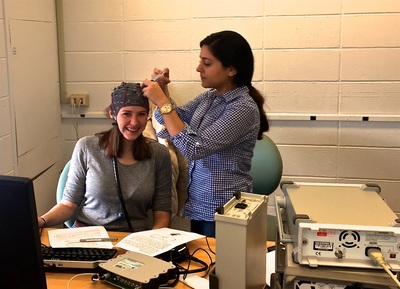
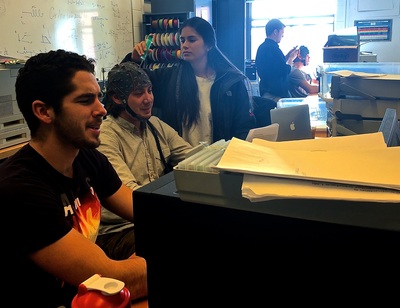
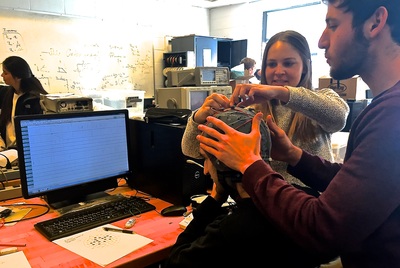
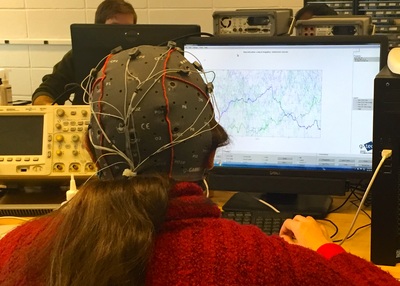
The course, offered by the departments of Electrical Engineering, Computer Science, and Biomedical Engineering, provides hands on experience with basic neural interface technologies. Topics include recording EEG signals using data acquisition systems (noninvasive, scalp recordings), real time analysis and monitoring of brain responses, and analysis of intention and perception of external visual and audio signals.
For more information on this course, please contact the instructor.
Course materials may be used for educational purposes only. Please cite:
Khalighinejad, Bahar; Long, Laura; Mesgarani, Nima, Designing a Hands-On Brain Computer Interface Laboratory Course, International Conference of the IEEE Engineering in Medicine and Biology Society (EMBC), Orlando, Florida, 2016. Download PDF
Course learning objectives
Experimental design
- Experiment design and optimization
- Data collection and quality control
- Hypothesis testing
Neuroscience concepts
- Neural mechanisms of EEG
- Biological artifacts
- Event related potentials (ERP), including mismatch negativity (MMN) and P300
- Neurofeedback
- Auditory steady state response (ASSR)
- Steady state visually evoked potential (SSVEP)
- Imagined movement
Data analysis
- Preprocessing: epoching and noise reduction
- Fast Fourier transform (FFT) and frequency domain processing
- Finite impulse response (FIR) filtering
- Common spatial pattern (CSP) filters
- Linear discriminant analysis (LDA) classification methods
- Cross session and cross subject modeling and evaluation
Technical skills
- Hardware setup and debugging
- MATLAB and Simulink
- EEG recording and analysis software
- Publicly available data analysis software including EEGLAB
Course materials
-
Introduction to EEG
labinstruction1.pdf -
Biological artifacts in EEG
labinstruction2.pdf -
Neurofeedback
labinstruction3.pdf -
Auditory oddball paradigm
labinstruction4.pdf -
P300 speller
labinstruction5.pdf -
Auditory steady state response
labinstruction6.pdf -
Attentional modulation of ASSR
labinstruction7.pdf -
Steady state visually evoked responses
labinstruction8.pdf -
Decoding imagined movement
labinstruction9.pdf -
Project 1
miniproject1.pdf -
Project 2
miniproject2.pdf